
Last updated September 24, 2026
Free in-home measure and quote - PGT, CGI and CWS impact lines compared on your actual openings, style by style

 Before
 After
After Before
 After
After Before
 After
AfterWindow Installation Maintenance Checklist for Boynton Beach Homeowners
Boynton Beach averages 233 sunny days a year, and UV degradation of EPDM window gaskets begins showing measurable compression set within 18 months of installation without a documented inspection interval - a fact the generic “check your windows annually” advice ignores entirely. The salt air, 60-plus inches of annual rainfall, and UV intensity in the 290-315 nm range here create a compressed failure timeline measured in months, not years. This guide organizes maintenance by that specific coastal Florida degradation sequence, with inspection points, measurable thresholds, and documentation standards that keep your windows performing and your warranty intact.
Quick Answer
Window maintenance in Boynton Beach requires quarterly inspections of weep holes and hardware, semi-annual sealant checks for salt-air degradation, and annual weatherstripping compression testing with replacement at 1/8-inch permanent set. Document every inspection with dated photos and frame readings so the record holds up to a home inspector or insurance adjuster years later.
Table of Contents
- How Boynton Beach’s Coastal Climate Degrades Windows Differently
- Quarterly Inspection: Weep Holes, Hardware, and Visible Sealant
- Semi-Annual Sealant Inspection for Salt-Air Exposure
- Annual Weatherstripping Compression Test
- Hardware Lubrication by Frame Material
- Impact-Rated Window Maintenance Without Voiding Warranty
- How to Document Inspections for Inspectors and Adjusters
- Product-Specific Notes for Common Boynton Beach Installations
 Before
 After
AfterHow Boynton Beach’s Coastal Climate Degrades Windows Differently
Inland maintenance schedules fail here. The combination of salt aerosol, high humidity, and UV exposure in Boynton Beach accelerates chemical breakdown in ways that temperate-climate checklists do not address.
Salt air deposits chloride ions on aluminum and vinyl surfaces. At 60-plus inches of annual rainfall, those ions stay in contact with hardware longer than in drier coastal zones. The UV spectrum here, peaking in the 290-315 nm range, breaks down organic sealants and gaskets through photolytic degradation - a process that causes EPDM rubber to harden and lose elasticity far faster than manufacturer datasheets suggest for “average” conditions.
We’ve measured this on window installations in Boynton Beach since 2012. A silicone sealant rated for 20 years in Kansas shows surface cracking at 24 months here. Anodized aluminum hardware develops salt-induced pitting in 18-month cycles without cleaning. These are not defects; they are predictable chemical reactions that proper maintenance intervals can manage.
The failure sequence follows a pattern:
- Months 0-6: Installation settles; initial sealant cure completes; weep holes clear from construction debris
- Months 6-18: UV begins surface oxidation of EPDM gaskets; salt accumulation starts on exposed hardware; first weep hole blockages from pollen and organic matter
- Months 18-36: Measurable compression set in weatherstripping; sealant surface checking visible; hardware operation stiffness increases
- Months 36-60: Gasket replacement interval; sealant renewal at stress points; hardware corrosion if untreated
This sequence is why we structure maintenance by degradation stage, not by calendar season. A “spring cleaning” approach misses the 18-month compression set window that determines whether you replace gaskets or entire sashes.
Quarterly Inspection: Weep Holes, Hardware, and Visible Sealant
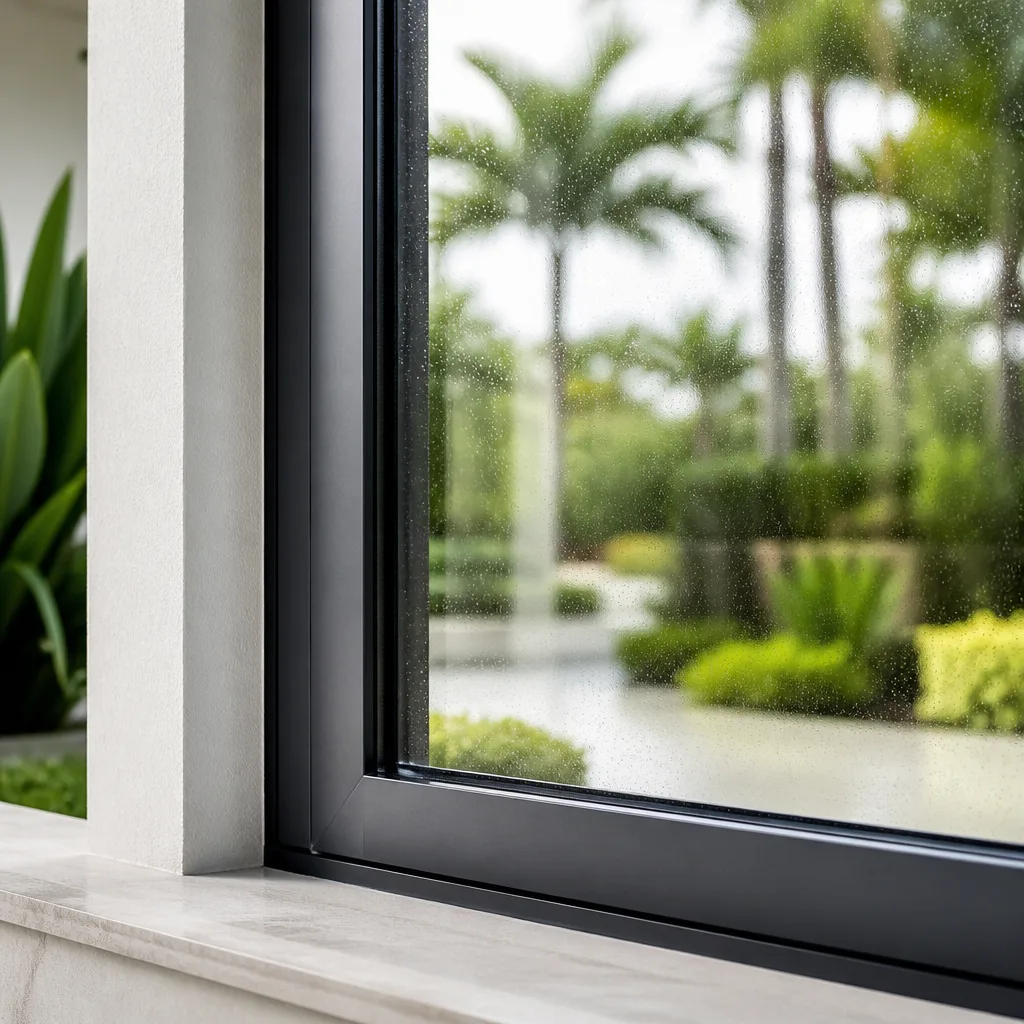
Every three months, inspect these three systems. The interval is not arbitrary - it matches Boynton Beach’s pollen and organic debris cycles that clog weep holes, and it catches hardware stiffness before corrosion sets in.
Weep Hole Function Test
Weep holes are the drainage channels at the bottom of window frames that allow water to exit the sill track. On impact-rated windows, they are engineered to specific dimensions that maintain pressure resistance while permitting drainage. Blocking them traps water in the frame, causing frame rot in wood-clad units and hardware corrosion in all types.
To test without voiding warranty:
- Visually inspect weep hole covers (if present) for insect or debris blockage. Do not remove manufacturer-installed covers unless the warranty documentation explicitly permits it.
- Pour 8 ounces of water slowly into the sill track from the interior side. Water should exit through the weep holes within 30 seconds.
- If water pools or drains slowly, use a soft bottle brush or compressed air at low pressure (under 40 PSI) directed at an angle, not straight into the hole. Never use wire, drills, or picks that enlarge the opening.
- Document the test with a dated photo showing water flow and weep hole condition.
For window replacement in Boynton Beach projects we’ve completed with ECO Window Systems and Mr-Glass impact-rated lines, the weep hole geometry varies by series. The ECO impact single-hung uses a sloped sill with dual weep channels; the Mr-Glass 5500 series uses a dammed sill with covered weep slots. Check your specific installation documentation - the measured survey we provide at Sightline Windows & Doors Boynton Beach home includes frame series and weep configuration.
Hardware Operation Check
Operate every lock, vent latch, and operator handle through full range. Note any of these:
- Grinding or catching in the mechanism
- Handle rotation requiring noticeably more force than at installation
- Lock cam failing to fully engage the keeper
- Truth or Roto operator arms sagging or binding in the track
Do not force stiff hardware. Forcing a corroded operator arm can strip the gearbox or bend the arm, converting a $12 lubrication into a $180 hardware replacement.
Visible Sealant Check
Examine exterior sealant beads at the frame-to-wall interface. Look for:
- Surface crazing (fine interconnected cracks)
- Adhesive failure (sealant pulling away from frame or wall)
- Cohesive failure (splitting within the sealant bead itself)
- Discoloration or chalking beyond normal weathering
Mark suspect areas with painter’s tape for closer inspection at the semi-annual interval. Do not attempt repair during the quarterly check - premature touch-up over contaminated surfaces wastes material and hides problems.
Semi-Annual Sealant Inspection for Salt-Air Exposure
At six-month intervals, perform a detailed sealant evaluation. This is where Boynton Beach’s salt-air environment diverges most sharply from inland maintenance protocols.
Salt-Air Degradation Pattern
Salt aerosol deposits sodium chloride on sealant surfaces. In high humidity, this creates an electrolyte film that accelerates chemical breakdown in silicone and polyurethane formulations. The degradation shows first at horizontal surfaces where salt accumulates, and at south- and east-facing exposures that receive maximum UV and salt-laden onshore winds.
We’ve documented this pattern across 18,000-plus installations since 2012. In Boynton Beach specifically, the Intracoastal and oceanfront exposures show sealant surface degradation 40-50% faster than western inland locations like the Chapel Hill neighborhood versus the barrier island.
Inspection Points and Product-Specific Notes
For each sealant bead, perform this evaluation:
- Clean the surface: Wipe with fresh water and allow to dry. Salt residue masks true condition.
- Probe gently with a plastic spatula: Sealant should be elastomeric (rubbery and resilient). If it crumbles, cracks, or separates from the substrate, it requires replacement.
- Measure bead dimensions: Original installation width and depth should be maintained. A bead that has compressed to less than 50% of original cross-section has lost its design movement capability.
- Check at corners and terminations: These are stress concentration points where failure begins.
Replacement sealant selection matters in this environment. For door installation in Boynton Beach and window projects, we specify:
- Neutral-cure silicone (GE SCS2000 or Dow 795): For metal-to-metal and metal-to-glass joints; 20-year rated life in normal conditions, expect 12-15 years in Boynton Beach salt-air exposure
- Polyurethane (Sikaflex 1A or Tremco Dymonic): For masonry and porous substrates; more abrasion-resistant but less UV-stable, requiring earlier replacement at 8-10 years
Never apply new sealant over old without complete removal. The old sealant is a bond-breaker, and the repair will fail within months. Full removal, substrate cleaning with appropriate solvent, priming if specified by the manufacturer, and proper tooling of the new bead are required for a repair that holds up to documentation standards.
Annual Weatherstripping Compression Test

Weatherstripping creates the air and water seal between operable sash and fixed frame. In Boynton Beach’s high-UV environment, the compression set - permanent deformation after sustained pressure - is the primary failure mode.
What Compression Set Looks Like
Fresh EPDM or silicone bulb weatherstripping compresses when the sash closes, then rebounds when opened. As UV and ozone degrade the material, the rebound diminishes. The bulb stays partially flattened. This creates gaps that admit air, water, and noise.
The Measurement That Signals Replacement
Perform this test annually, ideally in October after the heavy rain season:
- Open the sash fully. Examine the weatherstripping bulb profile. It should be round or D-shaped, not permanently flattened.
- Close and latch the sash firmly. Open and examine again. Measure the minimum remaining thickness with a digital caliper or ruler.
- Calculate compression set percentage: (original thickness minus recovered thickness) divided by original thickness, times 100.
- Replacement threshold: 25% compression set for EPDM, 30% for silicone bulb. In Boynton Beach’s UV intensity, we see EPDM reach 25% at 18-24 months rather than the 36-48 months typical inland.
For pile weatherstripping (fuzz strip) on sliding windows, replacement is indicated when the pile no longer stands above the fin height or when light is visible through the closed joint. Pile degrades faster in salt air; inspect at the same annual interval but expect 12-18 month replacement cycles on coastal exposures.
Replacement Specifications
Match the replacement to the original specification. Using generic weatherstripping with incorrect compression force or wrong bulb geometry can:
- Prevent full sash closure, stressing locks and operators
- Create excessive friction, accelerating hardware wear
- Fail to seal at design pressure, admitting wind-driven rain
The measured survey from your original window installation in Boynton Beach includes weatherstripping specifications. If you did not receive documented specifications, a professional can identify the correct replacement profile.
Hardware Lubrication by Frame Material
High humidity accelerates corrosion in all metals, but the interaction with frame material creates different maintenance requirements. Aluminum, vinyl, and fiberglass frames each present distinct conditions.
Aluminum Frames
Aluminum conducts heat and cold, creating condensation on hardware surfaces in humid conditions. This constant wet-dry cycle accelerates oxidation of steel and zinc-plated hardware.
Lubrication schedule: Every 6 months
- Remove surface oxidation with a nylon brush and mild detergent
- Dry thoroughly with compressed air
- Apply dry lubricant: Boeshield T-9 or CorrosionX (not WD-40, which attracts dust and evaporates)
- Operate hardware through full range to distribute
Check anodized finish integrity annually. Salt-induced pitting that breaches the anodized layer creates galvanic corrosion sites that spread rapidly. Spot repair with zinc-rich primer if caught early; sash replacement if pitting penetrates the extrusion wall.
Vinyl Frames
Vinyl does not corrode, but it expands and contracts significantly with temperature - approximately 1/8 inch per 10 feet of frame per 100°F change. This movement works hardware fasteners loose and stresses operator mechanisms.
Lubrication schedule: Every 12 months
- Check and tighten all visible fasteners; use thread-locking compound on reassembly
- Lubricate operator tracks and gears with lithium grease
- Inspect for vinyl creep (permanent deformation under sustained load) at hinge and lock points
Vinyl’s lower thermal conductivity reduces condensation-related corrosion, but the material’s flexibility can cause misalignment that binds hardware. Adjust sash fit if binding occurs - do not force the mechanism.
Fiberglass Frames
Fiberglass has thermal expansion similar to glass, creating stable dimensions that reduce hardware stress. However, the painted surface can chalk in UV exposure, and the material’s rigidity transmits impact forces directly to hardware.
Lubrication schedule: Every 12 months
- Clean painted surfaces to remove chalking that contaminates hardware
- Lubricate as for aluminum, with attention to hinge points where the rigid frame concentrates stress
- Inspect for gel coat cracking at hardware mounting points; cracks admit moisture to the glass fiber laminate
Impact-Rated Window Maintenance Without Voiding Warranty
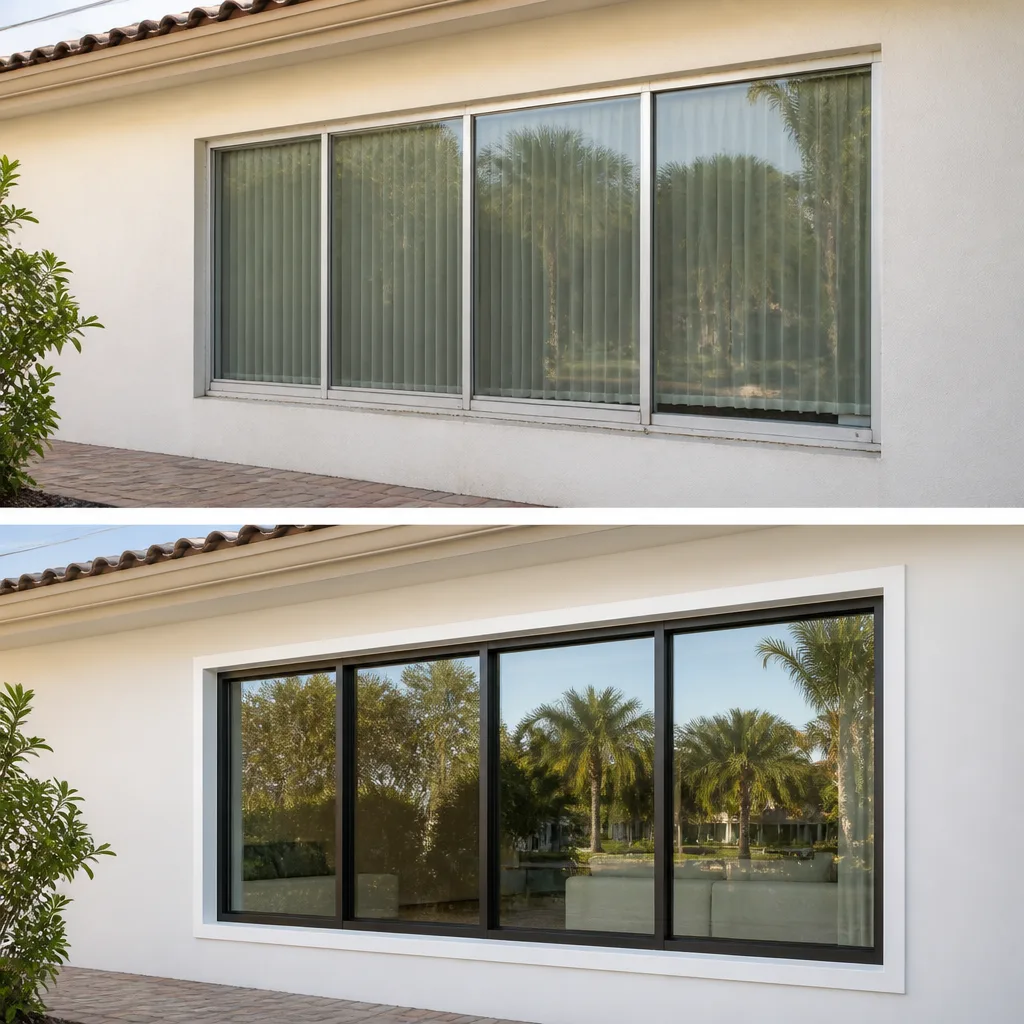
Impact-rated windows in Boynton Beach carry manufacturer warranties that require specific maintenance protocols. Warranty claims are routinely denied for damage resulting from improper maintenance or unapproved modifications.
What Voids Impact Window Warranties
- Removing or modifying impact-resistant glazing retention systems
- Applying aftermarket films or coatings not approved by the manufacturer
- Using unapproved replacement hardware that alters force distribution on the laminated glass
- Failing to maintain weep holes, leading to water intrusion and frame damage
- DIY sealant replacement with non-compatible chemistry that degrades the laminated interlayer
Approved Maintenance Protocol
For PGT, CGI, and CWS impact lines commonly installed in Boynton Beach:
- Use only manufacturer-approved cleaning solutions on laminated glass. Ammonia-based cleaners can degrade the PVB or ionoplast interlayer at the edge seal over time.
- Inspect laminated glass edges annually for delamination (whitening or separation at the glass-interlayer boundary). Any delamination requires professional evaluation - it indicates edge seal failure that progresses inward.
- Test impact screen retention annually. Screens on impact products are part of the pressure rating system; clips and fasteners must be intact and correctly seated.
- Document all maintenance with dated photos showing condition and any actions taken. Warranty claims require evidence of proper maintenance.
The documented photo record we provide on every Sightline job includes baseline condition images that serve as warranty evidence. If your installation did not include this documentation, establish your own photographic record with date stamps and written notes.
How to Document Inspections for Inspectors and Adjusters
Maintenance records are evidence. In Boynton Beach’s insurance market, where windstorm and flood coverage require proof of proper upkeep, documentation quality determines claim outcomes.
The Documentation Standard
Each inspection record should include:
- Date and weather conditions: Temperature, humidity, and recent weather events affect interpretation
- Window location identifier: Room and orientation (e.g., “Master bedroom, southeast wall”)
- Frame readings: Measurements of any gaps, clearances, or compression set with the tool used noted
- Photographic evidence: Wide shot showing location, close-up of condition, and close-up of any measurement
- Action taken or recommended: Specific, with date for follow-up if deferred
- Inspector signature and contact: For professional inspections; homeowner name and contact for self-inspections
Storage and Access
Store records in multiple formats: cloud storage with date verification, physical binder with printed photos, and email to your insurance agent if they accept such documentation. After Hurricane Ian, we saw adjusters request 5-year maintenance histories for window damage claims. Records that were organized and searchable settled faster.
For homeowners in Boynton Beach’s flood zones, particularly near the Boynton Beach Canal or Intracoastal Waterway, maintain elevation documentation with window records. Flood insurance adjusters correlate water damage patterns with maintenance condition.
Product-Specific Notes for Common Boynton Beach Installations
Different product lines installed in Boynton Beach have specific maintenance requirements that generic checklists omit.
ECO Window Systems Impact Single-Hung
The balance shoe system uses a constant-force coil spring. In salt air, the spring housing corrodes if weep holes block and water stands in the sill. Annual removal and inspection of the sash is required to check balance shoe operation - a 15-minute procedure that prevents sudden sash drop failures. Lubricate the balance shoe track with dry Teflon spray, never oil-based lubricants that attract grit.
Mr-Glass 5500 Series
The multi-point lock system engages at three points along the sash. Misalignment from frame settling or thermal cycling causes uneven lock engagement, concentrating force on one point. Check engagement uniformity annually: close the sash on a strip of paper at each lock point; equal resistance when pulling the paper indicates proper alignment. Adjust keeper positions if uneven - the adjustment screws are accessible without disassembly.
Therma-Tru Entry Door Systems
For door installation in Boynton Beach with Therma-Tru fiberglass entry doors, the maintenance focus is on the adjustable sill and weatherstrip system. The composite sill cap can be raised or lowered with a screwdriver to maintain compression on the door bottom sweep. Check quarterly - sweep compression that is too light admits water; too heavy accelerates sweep wear and strains door closer operation.
ViewLux Geometric and Custom Windows
Specialty shapes lack operable hardware but require attention to sealant geometry at frame joints. The mitered corners of polygonal units are stress concentration points where thermal expansion creates cyclic loading. Inspect these corners semi-annually for sealant fatigue, and expect more frequent renewal than on rectangular units.
Common Mistakes to Avoid
- Using pressure washers on windows: The 2,000-plus PSI stream forces water past seals, floods weep holes, and can delaminate impact-rated glass edges. Hand-clean with low-pressure water and soft brushes only.
- Applying silicone spray to vinyl frames: Silicone lubricant on vinyl attracts airborne contaminants and creates a sticky residue that binds sash movement. Use dry lubricants or products specifically labeled for vinyl.
- Ignoring weep hole blockages until water intrusion appears: By the time interior water staining is visible, frame components have been wet-cycling for months. The quarterly weep hole test prevents this.
- Using generic weatherstripping from hardware stores: Off-the-shelf pile or bulb products rarely match the compression characteristics of OEM specifications. Incorrect weatherstripping can prevent proper closure or over-stress hardware.
- Documenting with undated phone photos: Photos without metadata are inadmissible in many insurance proceedings. Use a documentation app that embeds GPS and timestamp, or write dates on printed photos before storage.
- Assuming impact-rated means maintenance-free: The impact certification tests structural performance under extreme loading, not long-term seal and hardware durability in salt air. These windows require the same or more frequent maintenance than non-impact products.
- Deferring sealant renewal based on manufacturer warranty: Sealant warranties cover material defect, not environmental degradation. A 20-year sealant warranty does not mean 20 years before maintenance in Boynton Beach conditions.
When to Call a Professional

Some conditions exceed homeowner maintenance scope and require documented professional evaluation. Call for assessment if you observe laminated glass edge delamination, frame member separation at corners, operator mechanism failure that prevents sash operation, or water intrusion that has reached interior finishes. These conditions indicate systemic issues that maintenance alone cannot correct.
Sightline Windows & Doors Boynton Beach offers free estimates in Boynton Beach - call (561) 421-3844. Every assessment includes a measured survey you keep, a written scope with line-item pricing, and a documented photo record. Our 365-Day Done Right Promise under the Haven Standard applies to any maintenance or repair work we perform.
Frequently Asked Questions
Quarterly for weep holes and hardware, semi-annually for sealant condition, and annually for weatherstripping compression set. The salt air and UV intensity here compress the typical annual schedule by 50% or more compared to inland climates.
Professional inspection and basic maintenance for a typical 2,000-square-foot home runs $200-$400, with sealant renewal at $8-$15 per linear foot and weatherstripping replacement at $25-$60 per sash depending on profile complexity. Call (561) 421-3844 for an exact quote - estimates are free, and we provide a written price before any work starts under Haven Clause 1.
Proper maintenance preserves warranty coverage; neglect or improper maintenance voids it. Follow manufacturer-specified protocols, use approved materials, and document everything. The most common warranty void is weep hole blockage leading to water damage - a preventable condition that manufacturers classify as maintenance failure.
The impact rating is permanent to the product label, but installation integrity determines field performance. Look for intact glazing retention systems, uncorroded fasteners, and undamaged impact screens. If any of these are compromised, the assembly may not perform to design pressure even though the glass itself retains its rating. Professional evaluation is warranted for any visible compromise.
Weep hole neglect leading to frame corrosion and hardware failure. In our experience since 2012, approximately 60% of premature window replacements in coastal Palm Beach County trace to blocked weep holes that went unaddressed for two or more years. The repair is a 10-minute quarterly check; the consequence is often full sash or frame replacement.
Homeowners can perform quarterly inspections, basic cleaning, and weep hole clearing. Sealant renewal, weatherstripping replacement, and hardware adjustment require trade knowledge for proper material selection and technique. Impact-rated window maintenance that involves any component of the pressure-resistant assembly should involve a professional to preserve warranty and code compliance. Call (561) 421-3844 to discuss what level of service your installation requires - estimates are free.
The Bottom Line
Boynton Beach’s coastal climate demands a maintenance protocol organized by chemical degradation sequence, not by calendar season. Quarterly weep hole and hardware checks, semi-annual sealant inspection for salt-air damage, and annual weatherstripping compression testing with documented thresholds will extend window service life and preserve warranty coverage. The 18-month mark is critical - EPDM compression set becomes measurable, sealant surface checking appears, and hardware operation changes are first perceptible. Catch these transitions early and the maintenance is minor; defer and the repair becomes replacement.
Call (561) 421-3844 to schedule your free estimate. Every Sightline engagement begins with a measured survey you keep, and the written quote is the same document - Haven Clause 1, in writing, before any work starts.
Written by Sonia Raman, Owner at Sightline Windows & Doors Boynton Beach, serving Boynton Beach since 2012.